
Origin
The native home of the Gyr or Gir breed of cattle is in the Gir hills and forests in the south of the Kathiawar peninsula on the west coast of India. In the adjacent States of Junagarh, Bhavnagar, and in Amreli Prant of Baroda State, they are bred extensively. Cattle having Gir blood are, however, met with over a wide area including north Kathiawar up to Cutch, western Rajputana, the northern part of Bombay State and as far south as the western portion of Hyderabad State. Most of the States in Kathiawar maintain pure herds of Gir cattle. Definite contributions of Gir blood are in evidence in the following breeds of cattle: Mewati Red Sindhi, Deoni and Nimari.
Conditions in the Native Home of the Breed
Location, Topography and Soils
The area covered by the breed is south of the Tropic of Cancer between 20°5′ and 22°6′ north the longitudinal position is approximately between 70° and 72° east. The area covered by the Gir hills and forests is approximately 1,500 square miles but the breed spreads besides this area into Junagarh State to the east and Amreli Prant of Baroda and Bhavnagar to the west which would cover about 6,000 to 7,000 square miles.
The surface of the area is for the most part undulating, the altitude of the region varying from 420 to 1,925 feet above sea level. The Gir range of hills is low, the highest peak being 3,666 feet above sea level. Some of the low-lying valleys between Gir ranges
are liable to floods. The ranges run west to east and are nearly parallel with the southern seacoast of Kathiawar. Though the area abounds in streams, ponds and wells, the only river of importance originating in the highest part of the G ir forest is Shatrangi, which drains into the Arabian Sea. In the Junagarh State area the rivers Ilhadar and Saraswati are important; they drain towards the western seacoast of Kathiawar.
Source: Zebu Cattle of India and Pakistan FOOD AND AGRICULTURE ORGANISATION Of THE UNITED NATIONS 1953
All the Gir hills being volcanic in origin, consist of trap and basalt. There is much variety in the texture, quality and depth of soil inhabited by the breed. The soil is generally black with scattered tracts of the lighter kind of soil. The soils of the Gir forests and adjacent areas are either light-coloured or red. Black soil is supposed to be very fertile but the lighter coloured and red soils respond well to the irrigation.
Climate
The climate of Kathiawar in general may be said to be temperate and pleasant, and the rainfall is moderate. The months of January, February and March are marked by heavy dews and thick fogs. The summer season begins in March and lasts till the end of June when the rain falls. The southern section is slightly hotter than the northern one. Monsoon begins in June and ends in October. Rainfall in the northern and central areas varies from 20 to 25 inches, while in the west, as in Junagarh, and
in the south, the annual rainfall averages about 40 to 45 inches.
Source: Zebu Cattle of India and Pakistan FOOD AND AGRICULTURE ORGANISATION Of THE UNITED NATIONS 1953
Even during the hot season, when occasional day temperatures may go as high as 105°F., the nights are pleasant and cool with plenty of breeze.
Vegetation
The Gir forest, though thickly wooded, is more extensively used for pasture purposes than as a source of timber. The principal trees found in the forest are Teak (Tectona grandis), black wood (Dalbergia Babul (Acacia arabica), Jambul (Eugenia sambolana), Hal( (Butea frondosa), Indian padauk (Acacia catechu). In areas other than the Gir forest there are not any important trees., Mangoes and Bassia latifolia are commonly found besides palms and Casuarina in coastal regions.
The following grasses are prominent varieties in the ‘forest area: Cynodon dactylon, Dichantium (Andropogon) annulatum Iseilema (Anthistiria) wightii, Iscilema (Anthistiria) laxum Ischaemum rugosum, Apluda varia, Themeda (Anthistiria) triandra, Heteropogon contortus, Chrysopogon montanus, Ischaemum pilosum, Cen-
chrus biflorus, Polytoca barbata.
The grass-growing season in the Gir forest and other pasture, areas of Kathiawar is between July and December. In the higher regions of the Gir hills pasturage is also available up to March or April and herds of cattle are usually taken there. Depending upon the quality and depth of soil and the availability of irrigation facilities, varieties of crops are grown in the area. The following are important from ,the point of view of the cattle industry as the by-products from these crops are utilised in cattle feeding: sorghum, millets, wheat, rice, pulses such as Phascolus mungo, Phascolus radiatus, Cajanus indicus, Cicer arietinum, Pisunt sativum, sugarcane; and of the garden crops, carrots are used for cattle feeding in some parts of the area. Cyamopsia psoralioides and Vigna catjang are also utilised to a certain extent as fodder crops.
Professional breeders maintain their cattle mostly on pastures. There is very little storage of grasses. Cultivators, on the other hand, make use of pastures to a limited extent as well as stovers, dried grass, etc. They also feed concentrates such as wheat bran, gram husk, pulse seeds, cottonseed, oilcakes, etc., to their milking animals and working bullocks.
Source: Zebu Cattle of India and Pakistan FOOD AND AGRICULTURE ORGANISATION Of THE UNITED NATIONS 1953
Management Practices
Besides cultivators who own only a few animals. Gir cattle are largely bred in Kathiawar by professional breeders known as Rabaris, Bharwads, Maldharis, Ahirs and Charm’s. These lead a nomadic life, moving their cattle from place to place in search of grazing. Good pasture is usually available from July to December; thereafter the pastures are scanty. From January onwards the animals are moved to the hillsides in the Gir forest where good pasture is available for the next 2 or 3 months. Grazing is permitted in most of the forest reserves and fees are realised by levying certain rates per head of cattle grazed. Calves are allowed to suck for 8 to 12 months and milking cows are usually retained in the village areas, but dry cows and weaned young stock are taken to the distant pastures. Bullocks and milking cows are fed concentrates such as wheat bran, crushed pulses, grain husk, oilcakes and cottonseed, and fodders such as stovers of sorghum and millets, dried grass or straws. Only the milking cows, bullocks and young calves are provided with shelter; other animals are not housed or sheltered. Herds maintained by many Rajas and chiefs in Kathiawar are partly stall-fed and partly maintained on pastures. Breeders take good care of the bull calves, which are sold to the cultivators to be trained as bullocks when they are about 18 to 24 months old. To make the best use of cow dung and urine there is a prevailing practice in Kathiawar to keep the animals herded in a field for 3 or 4 nights for which the owners of cattle receive some remuneration and at the same time some feed for their cattle.

By courtesy of Dr. S. S. Khot.
Physical Characteristics of the Breed
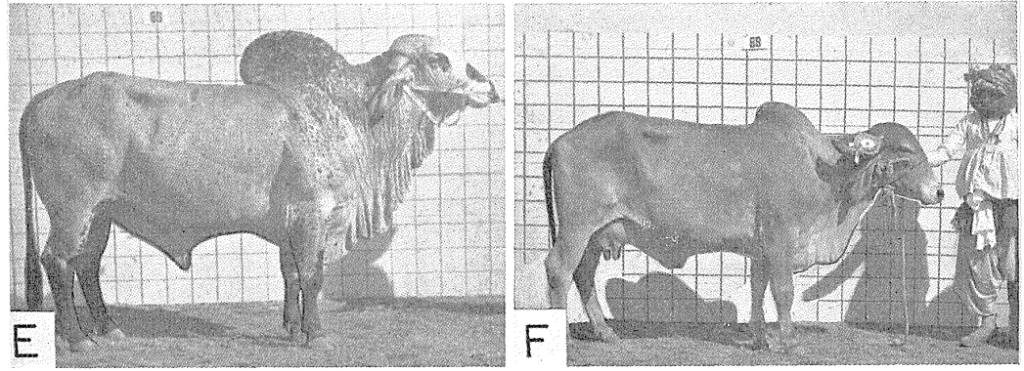
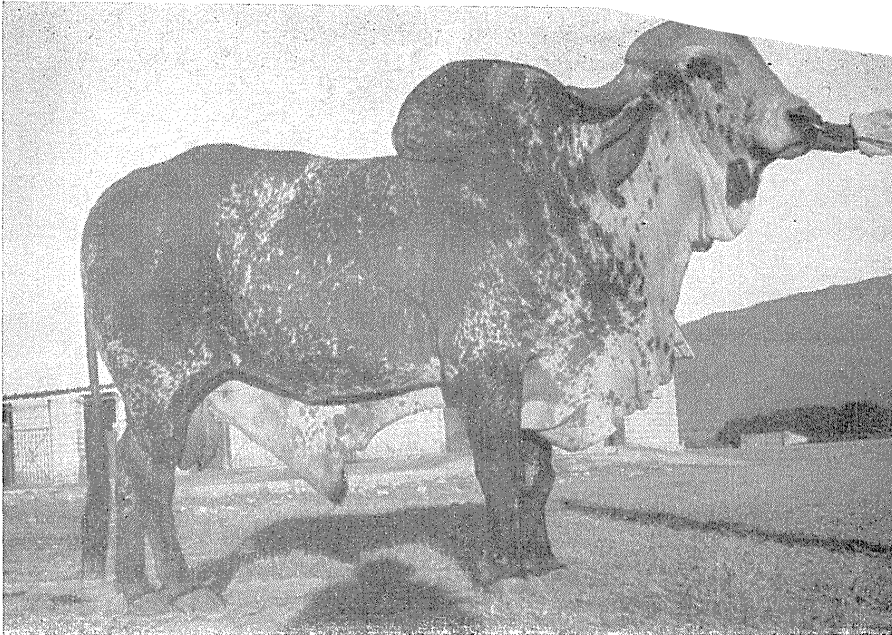
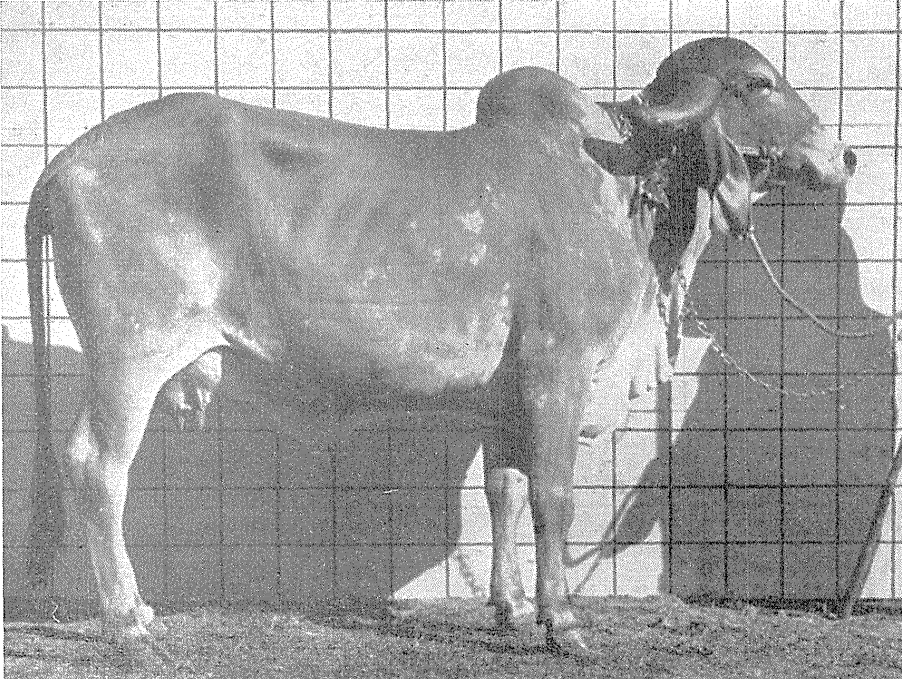
In purebred Girs, the entire red colour is sometimes encountered although it is usually mottled and varies from yellowish red to almost black. The popular colour is white with dark red or chocolate brown patches distributed all over the body. A well-defined patch of either dark or light colour, generally found on one or both sides of the body, is typical of the breed it may be noted, however, that this peculiar Gir colouring seems to be recessive. The most noticeable characteristic of the Gir is a very prominent and broad forehead, which forms a heavy, bony shield covering part of the head. This broad bony forehead overhangs the eyes to such an extent that they appear to be partially closed, thus giving these animals a sleepy appearance. The ears are markedly long and pendulous, opening to the front and resembling a curled up leaf, the points turning inward in such a way that particularly in young animals the’ tips almost meet under the jowl. There is a characteristic notch near the tips. Greatest width of ears varies from 5.5 to 9 inches while the length varies from 10 to 17 inches. Horn’s are peculiarly curved. Starting at the base of the crown they take a downward and backward curve and again incline a little upwards and forwards taking a spiral
inward sweep, finally ending in a fine taper. The dewlap is only moderately developed while the sheath in males is usually large and pendulous. The skin is loose, pliable
and of fine quality and the hair is short and glossy. Hooves are of medium, size and black in colour. They are supposed to be medium hard, and bullocks are usually shod when continuously working on hard roads.
Functional Characteristics of the Breed
Gir cows are fairly good milkers, though in their native home the variability in milk production is very large; in Bombay city and its suburban areas the breed is prized for this characteristic. Gir bullocks are extensively used as draft animals. They are heavy, powerful animals but are medium-paced in movement. Data collected (730 samples) show that the average percentage of fat in milk from Gir cows is 4.54, while average solids-not-fat percentage is 9.15 (Dastur and Kothavalla, 1946). The average age of heifers at their first calving is variable: it is estimated at 51 months. Later calvings are more regular, with intervals of 14 to 16 months. Although cows calve throughout the year there is a strong tendency, particularly observed in Kathiawar, that they calve more often in the months of January, February and May. Average birth weight of calves estimated from records at the Indian Dairy Research Institute at Bangalore is 56 pounds for males and 53 pounds for females. Gir bulls are put to service at an average age of 40 months and it is considered that Gir males are, to some extent, shy breeders. Bull calves are not weaned from their mothers until they are 8 to 10 months old and are usually allowed a fair share of the milk. The average breeding life of bulls is usually 7 years. The bullocks, if well-developed, are heavy, powerful animals.
They are even-tempered and are supposed to be good for long distance heavy transportation. In an iron-tired bullock cart they can haul about 1,200 pounds of weight for 20 miles in about 7 to 8 hours. They are extensively used in their native home for all agricultural operations such as plowing, harrowing, pulling water
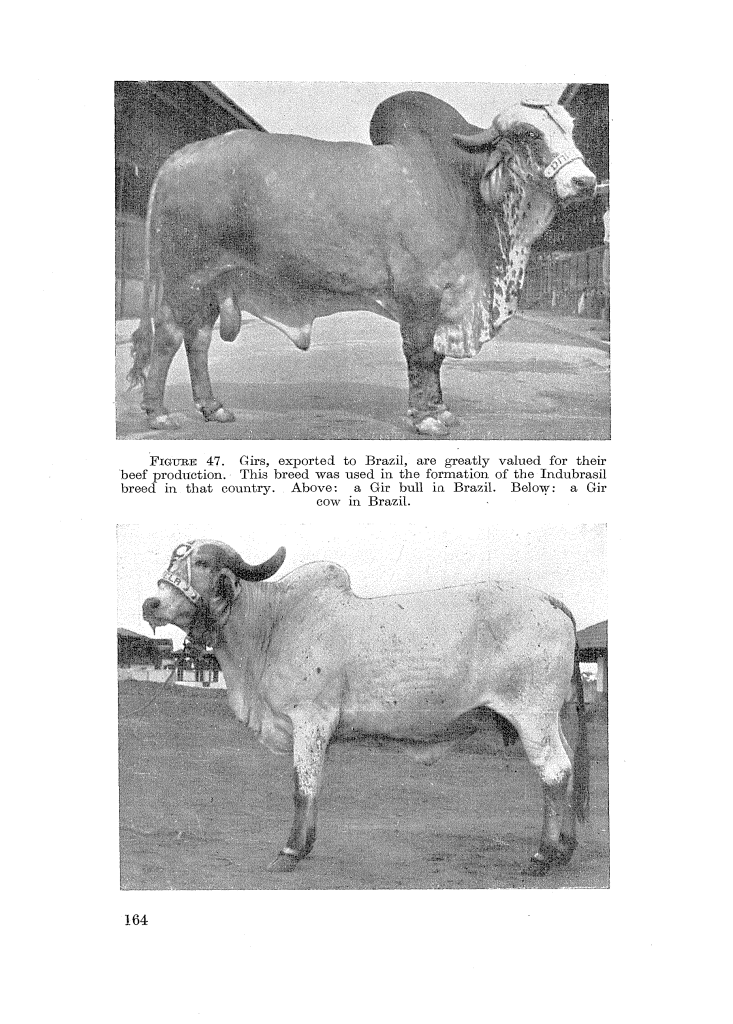
from wells, and transportation. On an average they work for 10 hours a day. Gir cattle are reputed to be the best beef cattle of India though they are not used for this purpose in India. They were exported to Brazil during the latter part of the 19th century and developed there as one of the important beef breeds. The Gir has played a prominent role in the evolution of Indubrasil cattle of Brazil.
Performance in Other Areas
Grading-up in India
Intentionally or unintentionally, Gir cattle have been used extensively for grading local cattle over a wide area of Western India from Cutch in the north to as far south as the Hyderabad State. Owing to the annual movement of Gir cattle in search of grazing, or in the course of transportation of goods on pack cattle, they have contributed their blood to the various breeds of cattle existing between western Rajputana and the eastern borders of Uttar Pradesh. Existence of Gir blood is clearly visible in Mewati, Deoni and Nimari breeds of cattle. It is also to be seen- in some Red Sindhi cows. Gir has also contributed to the formation of the Krishna Valley breed.
Pure herds of Gir cattle are maintained at Rajkot, Bhawnagar, Jamnagar, Junagarh, Bombay, Ahmednagar, Ahme- dabad, Ajmer and Bangalore. Purebred bulls from these herds are used to grade-up the local cattle from the surrounding areas.
Brazil
Gir cattle, known as Gyr in Brazil , were imported into SaoPaulo for the first time in 1890. Subsequent consignments came in until 1920. After that the importations were stopped. They are bred extensively in Central Brazil in the States of Minas Gerais, Sdo Paulo and Goias Mato Grosso. Gir cattle have been used for pure breeding as well as for grading and crossbreeding. The Indubrasil breed of cattle originated from crosses made between Gir and Kankrej (Anonymous, 1947). The climate prevalent in the area where Girs are extensively bred is tropical. The annual average temperature is 72.5°F. with variations of 5.4°F. to 12.6°F. The precipitation varies between 45 and 70 inches. From April to September is usually a dry period with rainfall as low as 2 inches. During October and until April: the pastures provide excellent feed for the cattle; the majority of the pastures are natural, but in advanced Brazilian regions there are also cultivated pastures. The following ‘species of grasses are prominent: Panieunt
maximum, Hyparrhenia (Anaropogon) rufa and Melinis minuti flora. Wherever purebred cattle are reared under superior management, supplementary-rations are fed to the Cattle during Periods of scarcity. The following feeds are usually used: corn, rice bran, wheat bran, cottonseed meal. Chopped sugarcane is .also used. Gir,
cattle, though primarily used for beef production, are also used for Milk production.
The color of the Gir, as accepted in Brazil, is red, white, red and white with spots, or yellow. ,It , is the conformation of the Girs which is prized most by the breeders, though, for beef production, the animals are on the smaller side. In appearance they are strikingly impressive. In Brazil, Gir cattle are utilized to produce beef on grassland feeding alone. It is observed that the females usually calve for the first time when they are about 39 ‘months old and that they mature sexually earlier in Brazil than in India, although exact data are lacking. There is no fixed breeding season and the animals are ready for mating in any season. Bulls are ready for service at the age of 2 years, having. an active breeding life of 8 to 10 years. In experiments carried out at the Experimental Breeding Center of Sertaozinho, it was noted that the dressed meat percent- age from Girs amounted to 62.1 percent. At the same centre it was observed that 2-year-old bullocks from Gir crosses weighed 1,195.3 pounds. It is noted (Anonymous, 1949 (b)) that from two lots of 5 Gir-cross cattle each, the average weights at slaughter were 842.5 and 833.7 pounds while the cold carcass weights were 495.2 and 496.1 pounds. It it noted from a study in Brazil (Veiga, 1945) that Gir cattle have a hereditary recessive sub-lethal factor of flexed limbs. Though no exact studies are available, the foraging capacity and resistance to tick-borne diseases amongst Gir are favorably regarded by breeders. Purebred Gir cattle are maintained at the Government Experimental Livestock Breeding Station near Uberaba for improvement and research. The station is located in a zone of tropical climate of semi-humid type having around 2,330 hours of direct sunlight in 12 months. The mean temperature is 70°F during the dry season and 74°F. during the rainy season. Of these two season, August is the driest month in the year with 55 percent of relative humidity : January being the most rainy month with 12.8 inches of rain. Annual rainfall in the region is 64.4 inches; the region has on average 125 days of rain during the year. The breeding season is planned to begin on 1 May and continues until the end of January : consequently, the calving season starts in the middle of February and continues through to the first half of November. Cows are allowed to calve in previously chosen pasture grounds and the calves are nursed by their Mothers. When the calves are about 81/2 to 9 months old, they are weaned and separated into sex groups, at which time bull calves are put on an additional feeding schedule which is a mixture of ground feeds having millets, rice or wheat bran and cottonseed meal with approximately 14 percent protein. Bulls are allowed to breed when they are 24 months old. Similarly, heifers are allowed to be bred When they are 24 to 27 months old In an experiment conducted at the Animal Genetics Laboratory in SA° Paulo to find out the influence of the environmental temperature on body temperature, it was observed that Gir cattle (average of 6 animals) registered average body temperatures of 101.0°F. and 102.0°F. when the atmospheric temperatures were 70.5°F. and S7.0°F. This may be compared to the body temperatures of European breeds of cattle (average of 89 animals representing 6 breeds) 101.0°F. and 103.5°F. when atmospheric
temperatures were 69.5°F. and 87.0°F. (Villares, 1943).
United States of America
Numerous strains of cattle from. India, including Gir, are bred in the Gulf Coast region of the United States, where they are commonly referred to collectively as Brahman cattle. Though Gir blood has not been maintained in a. pure form, its influence can be seen in many herds of so-called Brahman cattle in Texas, Louisiana. and Florida.
Australia
Zebus, or animals with Indian breeding were introduced into Australia from the U.S.A. In the 1933 importation there was a bull of Gir breeding. These animals were taken for a cross- breeding project to evolve strains which could stand tropical conditions and produce economically under those conditions.
Sources of Breeding Stock and Information Regarding the Breed
Though the largest concentration of Gir cattle is seen in Kathiawar, a number of important breeding herds are found in Bombay State. A breed registry of Gir cattle has been started under the guidance of the Indian Council of Agricultural Research, New Delhi, India.
The following may be contacted for further information regarding the breed and the availability of stock:
Livestock Expert to the Government of Bombay, Poona,
India.
Animal Husbandry Commissioner to the Government of India, New Delhi, India.
In Brazil, where pure stock is maintained., the following
agencies may be contacted for further information.
Department da Producao Animal, Postal Box 215-B, Sao Paulo.
Sociedade Rural do Triangulo Mineiro, Postal Box 39, Uberaba Minas Gerais.
Links
 Gyr Cattle