The Brazilian Dairy Gir Breeding Programme is a public-private partnership between the Brazilian Agricultural Research Corporation and the Brazilian Association of Dairy Gir Breeders, which was established in 1985 in order to improve the Gir indicine breed for milk production in tropical regions. It is the first breeding programme of its kind in the world, and has made use of various technical innovations over the years, including genomic predictions for thousands of Gir males and females. These predictions are mainly used by Brazilian breeders, but are also increasingly being utilised in other tropical countries in South America, Central America and Asia.
One of the major challenges in milk production in tropical areas is the impact of heat stress and recurrent parasite infestations on the fitness and productivity of cattle. The Gir breed, which originates from India, is better adapted to these conditions than European breeds, and has therefore been used in crossbreeding schemes to create dairy herds in the tropics. In Brazil, some breeders have also begun selecting purebred Gir for milk production in an effort to improve the performance of crossbred herds.
The breeding programme has had notable success in improving the productivity and reproductive performance of the Gir breed, with average milk yield increasing by 25% over the past two decades. It has also developed a genetic improvement programme for beef production using Gir, and there are now more than seven million Gir cows in Brazil, making it the third most populous breed in the country.
In addition to its work in Brazil, the programme has also collaborated with other countries in the tropics to enhance the productivity of their dairy industries. This includes providing technical assistance, training and genomic predictions to countries such as Colombia, Mexico and India.
Overall, the Brazilian Dairy Gir Breeding Programme has made important contributions to the improvement of the Gir breed for milk and beef production in tropical regions, and its public-private partnership model has proved to be a successful approach to breeding and genetic improvement in the dairy industry.
Genetic diversity is an important factor in the success and sustainability of a species. It allows for the adaptation of a population to changing environments and helps to protect against diseases. In the field of cattle breeding, understanding the genetic diversity of different breeds can inform breeding decisions and help to preserve genetic resources.
A study by Machado et al. analysed the genetic diversity of four cattle breeds using microsatellite markers. The breeds chosen for the study were Gyr, Nellore, Guzerat, and Holstein. DNA samples were collected from 18 animals of each breed and analysed using nine microsatellite primers.
The results of the study showed that the Holstein breed was the most distinct from the other breeds, with genetic distances of 1.15 to Gyr, 1.12 to Nellore, and 0.94 to Guzerat. The closest genetic distance was found between Guzerat and Nellore, at 0.25. A total of 64 alleles were detected across all four breeds, with each breed showing 53% of the total number of alleles. The average number of alleles per locus was 7.11 ± 3.21.
One of the most informative loci was BMS1237, which had an observed heterozygosity of 53%. The least informative locus was BMS3004, with only 12% observed heterozygosity. The overall average heterozygosity for the nine loci was 35%, and the expected value for Hardy-Weinberg equilibrium was 53%. This low heterozygosity suggests a high level of endogamy, or breeding within the same population, among the animals sampled within each breed.
Overall, this study provides valuable insight into the genetic diversity of different cattle breeds and has implications for breeding decisions and the preservation of genetic resources. Understanding the genetic makeup of different breeds can help to ensure the health and viability of the livestock industry.
Zebu cattle, also known as humped cattle or indicine cattle, are a type of domesticated bovine native to South Asia. They are characterised by a prominent hump on their shoulders, long ears, and a large dewlap. Zebu are adapted to hot, arid climates and are known for their ability to tolerate heat and resist diseases prevalent in tropical regions.
The origins of Zebu cattle can be traced back to the Indus Valley Civilization in ancient India, where they were used for milk, meat, and draught power. They were also considered sacred and played a significant role in cultural and religious practices.
Over the centuries, Zebu cattle were introduced to other parts of the world, including Africa, the Middle East, and South America, where they were crossed with local cattle breeds to create new strains. These crosses resulted in improved heat tolerance, disease resistance, and hybrid vigour in the offspring.
Today, Zebu cattle are found in many countries and make up a significant portion of the world’s cattle population. They are used for a variety of purposes, including meat, milk, and draught power.
In addition to their practical uses, Zebu cattle are also valued for their cultural and historical significance. They are an important part of the identity and heritage of many communities around the world and are often featured in art and literature.
In summary, Zebu cattle have had a significant influence on modern cattle breeds, particularly in tropical and subtropical regions of the world. Their adaptability and resistance to heat and disease have made them an important resource for farmers and communities.
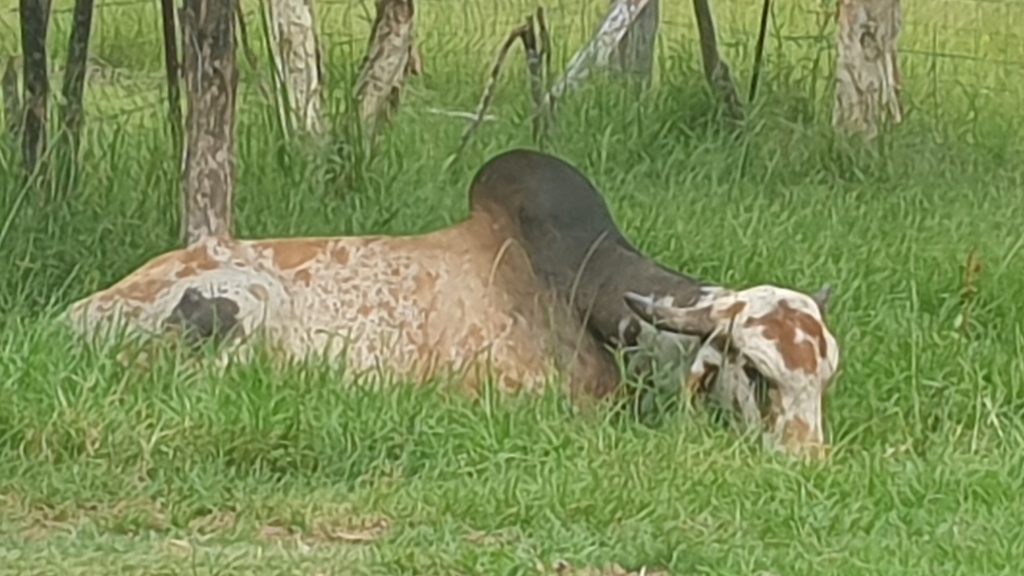
Subtropical areas of Australia currently (January 2022) experiencing substantial outbreaks of Bovine Ephemeral Fever (BEF). BFE is also known as Three-day Sickness although the symptoms can persevere for much longer. Up to 42 days in documented cases. Provision of care for down animals is important. Shade, water, dry feed and control of biting insects. Most, but not all animals will recover.
The Dep. of Primary industry says the following about BFE:
“Bovine Ephemeral Fever (BEF) is a viral disease of cattle and buffalo. Typically, affected animals are only sick for a few days, hence the alternative name – Three Day Sickness.
There is a sudden onset of fever- as high as 41°C compared with the normal temperature of about 380C. The temperature returns to normal within 36 hours.
The first sign in milking cows is a sudden and severe drop in milk production. Cows in advanced pregnancy may abort. This is probably because of the fever, rather than a specific effect of the virus.
Animals stop eating and drinking and become depressed. They usually drool saliva, develop a stringy nasal discharge, and may have watery eyes.”
Animals loose appetite and appear depressedThe sick animal can go down for the duration of the BEF
While the animal is still mobile it should be moved to a location where shade and water can be provided.
1- Racial: The head must have an ultra-convex profile, be medium, thin and dry, with a broad forehead and a skewer thrown back, without nimbure; straight, narrow and delicate bevel; muzzle black and broad, moist, with flared nostrils; thick, firm lips, large mouth and elliptical-shaped eyes, bright and darkly pigmented, protected by upper eyelid wrinkles and black eyelashes. Ears of medium length should be pendant, starting in the form of a tube wrapped around itself, then opening outwards, curving inwards at the tip and facing the face (“hawk”). The horns should be dark, symmetrical, thick at the base, protruding downwards and backwards, elliptical in section leading upwards and curving inwards, ideally.
2- Skin and Pigmentation: The hair must be fine, short and silky. The skin must be black or dark, which provides tolerance to sunlight, and it must also be loose, thin and flexible, soft and oily, and in the udder and inguinal region it must have a pink colour.
3 – Femininity: The Gir Leiteiro cow must have strong and clean bones. As for the angle, the animal must have a triangular shape, seen from the side, from the front and above, with great respiratory, cardiac and digestive capacity, with a wide croup. The Neck must be medium, light, oblique, high and well inserted to the head and harmoniously implanted to the trunk, with little evident musculature, fleshless, however, on the upper edge, the musculature is more developed. The dewlap should be medium, wrinkled, loose and flexible, starting for bifid below the ganacha.
4 – Back-Loin: Should have a long back-loin region, tending to straight, broad and strong. The dorsal-lumbar line must be proportional to the whole of the animal, balanced in terms of horizontality and width, long on the back (corresponding to the thoracic vertebrae and supporting the side, sheltering lungs and heart), wide on the loin (corresponding to the lumbar vertebrae, sheltering the digestive tract and pregnant uterus), following with a long pelvis and wide, apparent hips.
5 – Croup: The croup brings together several aspects: width, length and leveling, which will reflect a better or worse shape of the legs, feet and udder, as well as the ease of delivery. The ileum and ischium must be wide and spaced, keeping the proper proportions. It must have a good levelling of the croup, with an inclination between the ileum and ischium (croup angle) of 200 to 300. The sacrum bone must not protrude.
FUNCTIONAL CHARACTERISTICS:
Body Capacity – Cardio/Respiratory/Digestive:
1 – Chest: It must be broad and deep, with wide and long ribs, oblique and flat, well arched, far apart, without fat accumulation, indicating great cardio capacity -respiratory.
2 – Digestive Capacity: The abdomen must be long, wide, clean and high. It must be bulky, allowing the visualisation of the “barrel” shape, indicating great digestive capacity.
3 – Body Structure: A good dairy cow must have height and length compatible with its age. The ideal are medium sized animals, as they are the most efficient in a pasture production system.
4 – Flank: The flanks (empty) must have thin and evident skin and present a slight concavity.
Breast System:
1 – Udder: It must be broad, long, wide and deep, with a large milk storage capacity, volume compatible with the age and stage of lactation, making folds when empty. The consistency should be soft and elastic (glandular) and not fibrous (fleshy). Your floor should be level and not over the hock line. It must also show proportionality between the front and back. Forequarters should be advanced forward and attached to the belly and hindquarters well projected back and up.
2 – Central Ligament: It has great importance in milk producing cows. It must be strong and very evident, as it will guarantee the support and integrity of the udder, which must be well adhered to the inguinal region. When viewed from behind, the sulcus of the central suspensory ligament is evident. It is directly linked to the longevity of the udder and the permanence of the animal in the herd.
3 – Posterior Quarter: Responsible for 60% of milk production. It must be broad and bulky, with strong and well-adhered ligaments in the iguinal region.
4 – Forequarter: It should be large and voluminous, with a smooth insertion into the abdomen, having strong and well-adhered ligaments.
5 – Teats: They must be intact and symmetrical, 5 to 7 cm long, ± 3.3 cm in diameter, spaced apart, centred in the room, vertical and parallel, perpendicular to the ground.
6 – Vascularisation: It must be well shaped and with sufficient drainage through several apparent tortuous veins, preferably branched and penetrating through two or more orifices, in addition to having, in the abdomen, a large-calibre mammary vein.
Locomotor System:
1 – Forelegs: Forelegs should be medium in size with strong bone; long, oblique shoulder blades, harmoniously inserting into the thorax, arm and forearm with little evident musculature, with well-positioned knees and hands. The angle of the feet should be approximately 45 degrees.
2 – Hind Limbs: The legs must be clean, but with good muscle coverage, and should not have a pronounced culotte, with evident tendons and ligaments. Viewed from behind, the hind limbs should be well apart to make room for a full udder. It must have straight uprights, with strong joints, correct angulation and well-positioned hocks. The angle of the pasterns on the hooves should be approximately 45o.
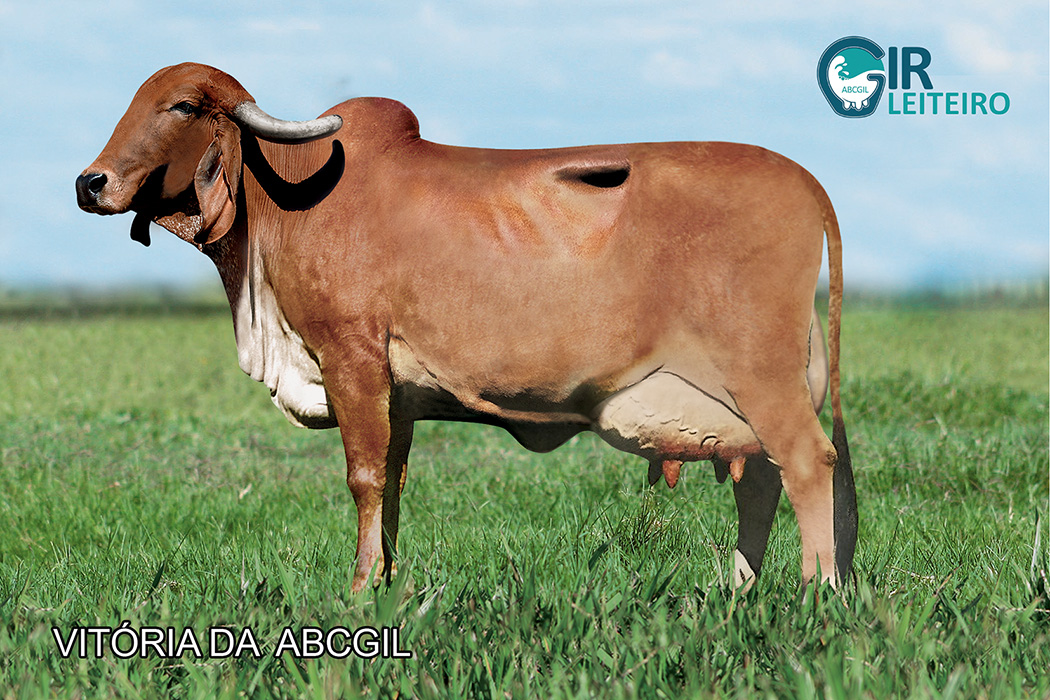
IDEAL TYPE (MODEL) The figure below shows the model of what would be the “Ideal Cow” of the Gir Leiteiro breed, where the main productive and functional characteristics were expressed:

 Gyr Cattle