http://girleiteiro.org.br/?conteudo/150 translation from Portuguese
Dairy Gir Leiteiro Cow Characteristics
General Appearance:
1- Racial: The head must have an ultra-convex profile, be medium, thin and dry, with a broad forehead and a skewer thrown back, without nimbure; straight, narrow and delicate bevel; muzzle black and broad, moist, with flared nostrils; thick, firm lips, large mouth and elliptical-shaped eyes, bright and darkly pigmented, protected by upper eyelid wrinkles and black eyelashes. Ears of medium length should be pendant, starting in the form of a tube wrapped around itself, then opening outwards, curving inwards at the tip and facing the face (“hawk”). The horns should be dark, symmetrical, thick at the base, protruding downwards and backwards, elliptical in section leading upwards and curving inwards, ideally.
2- Skin and Pigmentation: The hair must be fine, short and silky. The skin must be black or dark, which provides tolerance to sunlight, and it must also be loose, thin and flexible, soft and oily, and in the udder and inguinal region it must have a pink colour.
3 – Femininity: The Gir Leiteiro cow must have strong and clean bones. As for the angle, the animal must have a triangular shape, seen from the side, from the front and above, with great respiratory, cardiac and digestive capacity, with a wide croup. The Neck must be medium, light, oblique, high and well inserted to the head and harmoniously implanted to the trunk, with little evident musculature, fleshless, however, on the upper edge, the musculature is more developed. The dewlap should be medium, wrinkled, loose and flexible, starting for bifid below the ganacha.
4 – Back-Loin: Should have a long back-loin region, tending to straight, broad and strong. The dorsal-lumbar line must be proportional to the whole of the animal, balanced in terms of horizontality and width, long on the back (corresponding to the thoracic vertebrae and supporting the side, sheltering lungs and heart), wide on the loin (corresponding to the lumbar vertebrae, sheltering the digestive tract and pregnant uterus), following with a long pelvis and wide, apparent hips.
5 – Croup: The croup brings together several aspects: width, length and leveling, which will reflect a better or worse shape of the legs, feet and udder, as well as the ease of delivery. The ileum and ischium must be wide and spaced, keeping the proper proportions. It must have a good levelling of the croup, with an inclination between the ileum and ischium (croup angle) of 200 to 300. The sacrum bone must not protrude.
FUNCTIONAL CHARACTERISTICS:
Body Capacity – Cardio/Respiratory/Digestive:
1 – Chest: It must be broad and deep, with wide and long ribs, oblique and flat, well arched, far apart, without fat accumulation, indicating great cardio capacity -respiratory.
2 – Digestive Capacity: The abdomen must be long, wide, clean and high. It must be bulky, allowing the visualisation of the “barrel” shape, indicating great digestive capacity.
3 – Body Structure: A good dairy cow must have height and length compatible with its age. The ideal are medium sized animals, as they are the most efficient in a pasture production system.
4 – Flank: The flanks (empty) must have thin and evident skin and present a slight concavity.
Breast System:
1 – Udder: It must be broad, long, wide and deep, with a large milk storage capacity, volume compatible with the age and stage of lactation, making folds when empty. The consistency should be soft and elastic (glandular) and not fibrous (fleshy). Your floor should be level and not over the hock line. It must also show proportionality between the front and back. Forequarters should be advanced forward and attached to the belly and hindquarters well projected back and up.
2 – Central Ligament: It has great importance in milk producing cows. It must be strong and very evident, as it will guarantee the support and integrity of the udder, which must be well adhered to the inguinal region. When viewed from behind, the sulcus of the central suspensory ligament is evident. It is directly linked to the longevity of the udder and the permanence of the animal in the herd.
3 – Posterior Quarter: Responsible for 60% of milk production. It must be broad and bulky, with strong and well-adhered ligaments in the iguinal region.
4 – Forequarter: It should be large and voluminous, with a smooth insertion into the abdomen, having strong and well-adhered ligaments.
5 – Teats: They must be intact and symmetrical, 5 to 7 cm long, ± 3.3 cm in diameter, spaced apart, centred in the room, vertical and parallel, perpendicular to the ground.
6 – Vascularisation: It must be well shaped and with sufficient drainage through several apparent tortuous veins, preferably branched and penetrating through two or more orifices, in addition to having, in the abdomen, a large-calibre mammary vein.
Locomotor System:
1 – Forelegs: Forelegs should be medium in size with strong bone; long, oblique shoulder blades, harmoniously inserting into the thorax, arm and forearm with little evident musculature, with well-positioned knees and hands. The angle of the feet should be approximately 45 degrees.
2 – Hind Limbs: The legs must be clean, but with good muscle coverage, and should not have a pronounced culotte, with evident tendons and ligaments. Viewed from behind, the hind limbs should be well apart to make room for a full udder. It must have straight uprights, with strong joints, correct angulation and well-positioned hocks. The angle of the pasterns on the hooves should be approximately 45o.
IDEAL TYPE (MODEL)
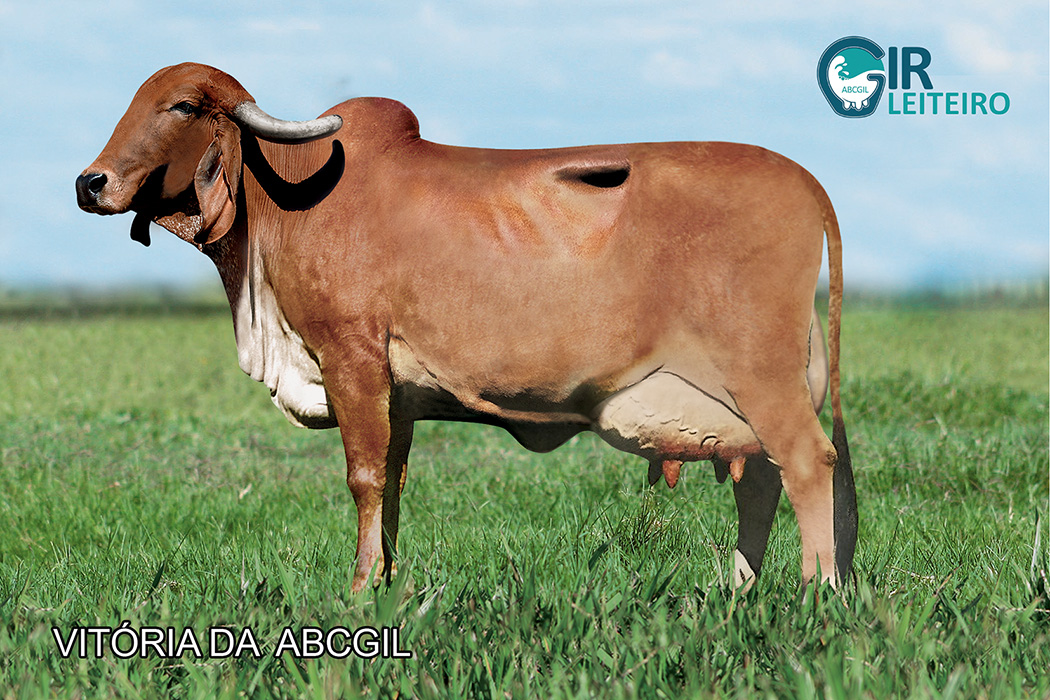
The figure below shows the model of what would be the “Ideal Cow” of the Gir Leiteiro breed, where the main productive and functional characteristics were expressed:

 Gyr Cattle