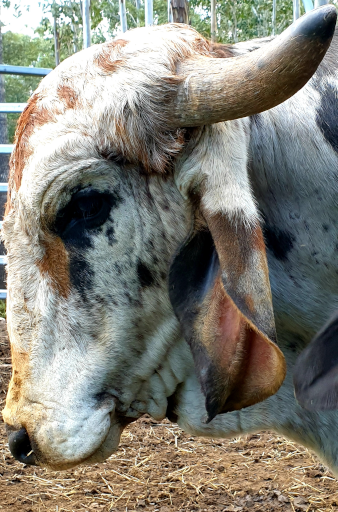
In purebred Gir’s, the entire red colour is sometimes encountered although it is usually mottled and varies from yellowish red to almost black. The popular colour is white with dark red or chocolate brown patches distributed all over the body. A well-defined patch of either dark or light colour, generally found on one or both sides of the body, is typical of the breed it may be noted, however, that this peculiar Gir colouring seems to be recessive. The most noticeable characteristic of the Gir is a very prominent and broad forehead, which forms a heavy, bony shield covering part of the head. This broad bony forehead overhangs the eyes to such an extent that they appear to be partially closed, thus giving these animals a sleepy appearance. The ears are markedly long and pendulous, opening to the front and resembling a curled up leaf, the points turning inward in such a way that particularly in young animals the’ tips almost meet under the jowl. There is a characteristic notch near the tips. Greatest width of ears varies from 5.5 to 9 inches while the length varies from 10 to 17 inches. Horn’s are peculiarly curved. Starting at the base of the crown they take a downward and backward curve and again incline a little upwards and forwards taking a spiral
inward sweep, finally ending in a fine taper. The dewlap is only moderately developed while the sheath in males is usually large and pendulous. The skin is loose, pliable
and of fine quality and the hair is short and glossy. Hooves are of medium, size and black in colour. They are supposed to be medium hard, and bullocks are usually shod when continuously working on hard roads.
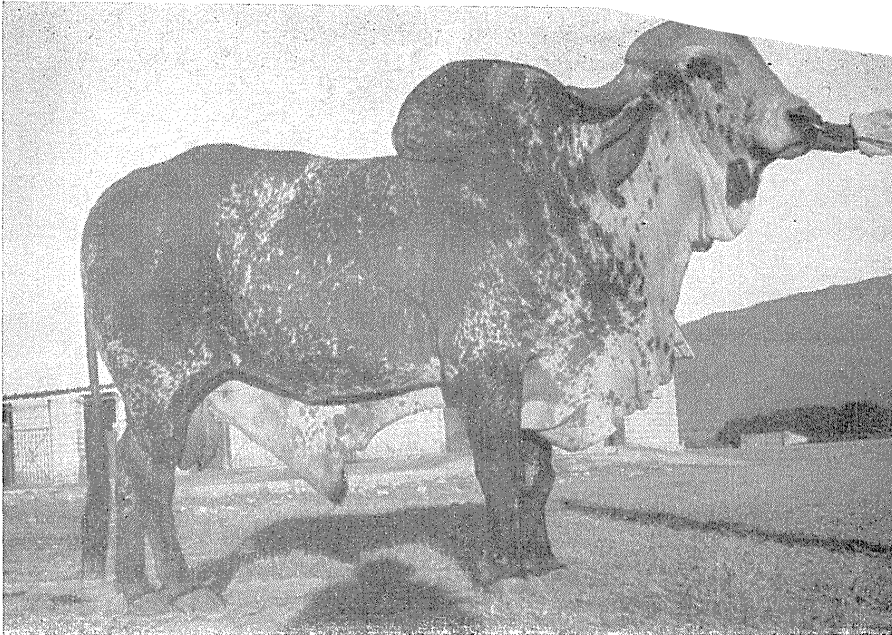
Source: Zebu Cattle of India and Pakistan FOOD AND AGRICULTURE ORGANISATION Of THE UNITED NATIONS 1953
Source: Zebu Cattle of India and Pakistan FOOD AND AGRICULTURE ORGANISATION Of THE UNITED NATIONS 1953 Research Papers
 Gyr Cattle