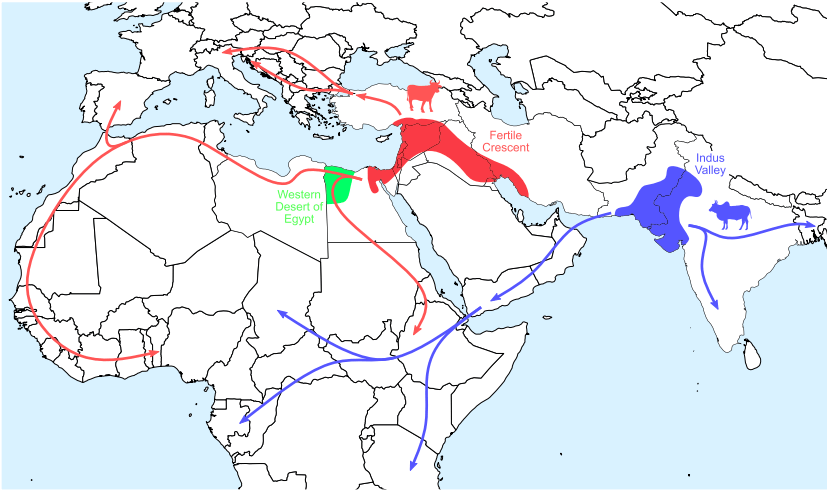
Domestic cattle are classified into two major species, the taurine or humpless cattle (Bos taurus) and the zebu or humped cattle (Bos indicus). Both descend from the wild aurochs (Bos primigenius). More precisely, the subspecies B. p. primigenius in Southwest Asia and B. p. nomadicus in India were the ancestors of taurine and zebu cattle, respectively. (1)
India is believed to be the centre of origin of Zebu cattle, Bos indicus, which later spread to Africa and southeast Asia. Domestication took place in the Indus Valley from Bos primigenius nomadicus, separated from the taurine branch ~250–330,000 YA, eventually giving rise to the extant indicine cattle (Bos indicus), often also termed zebu cattle (Loftus, MacHugh, Bradley, Sharp, & Cunningham, 1994). Indicine cattle also dispersed far beyondtheir domestication centre in the Indus Valley, reaching China and much of South-East Asia.
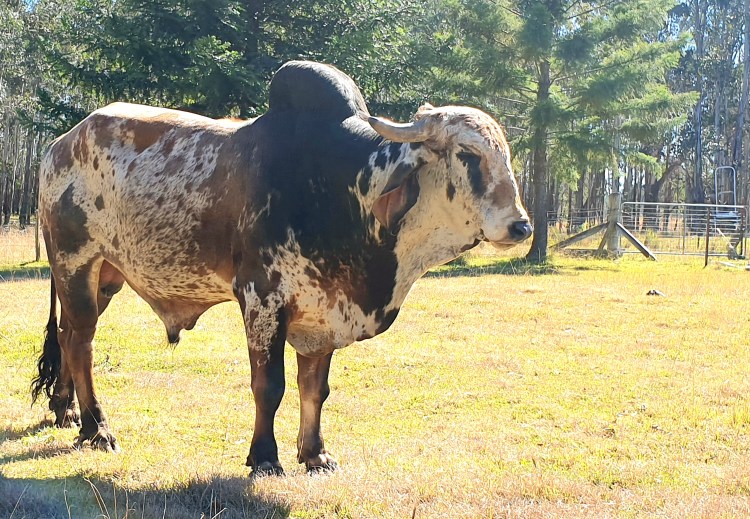
The native home of the Gyr or Gir breed of cattle is in the Gir hills and forests in the south of the Kathiawar peninsula on the west coast of India. In the adjacent States of Junagarh, Bhavnagar, and in Amreli Prant of Baroda State, they are bred extensively. Cattle having Gir blood are, however, met with over a wide area including north Kathiawar up to Cutch, western Rajputana, the northern part of Bombay State and as far south as the western portion of Hyderabad State. Most of the States in Kathiawar maintain pure herds of Gir cattle. Definite contributions of Gir blood are in evidence in the following breeds of cattle: Mewati Red Sindhi, Deoni and Nimari. (3)
- Piera Di Lorenzo 2016, http://dx.doi.org/10.1016/j.ejbt.2016.07.001
- D. Pitt 2018, DOI: 10.1111/eva.12674
- Zebu Cattle of India & Pakistan, FOOD AND AGRICULTURE ORGANIZATION Of THE UNITED NATIONS ROME, ITALY – MARCH, 1953
 Gyr Cattle